
Interview of Associate Professor (Special Appointment) Eiko Iwakoshi
Can Humans Hibernate?—Uncovering the Functions of Neuropeptides Involved in Fat Accumulation Among Hibernating Species

| Program | JST FOREST (Fusion Oriented REsearch for disruptive Science and Technology) Program | Researchers selected in the FY | 2024 |
|---|
Searching for Bioactive Peptides that Regulate Body Function
Why can squirrels and bears hibernate but not humans? That is the kind of problem I seek to solve in my area of specialty, animal physiology, that is, the study of animal body function. My primary interest lies in the field of comparative physiology, which involves the examination of functional processes across different species to elucidate both the unity and diversity of biological systems. Different species exhibit different physiological characteristics; however, what causes these differences? I want to know whether there is a way to instill a particular function of one animal (e.g., hibernation) in another.
My research focuses on bioactive substances called peptides, which are links of two or more amino acids. I began my research on peptides as an undergraduate at Hiroshima University, and my graduation research project was on the discovery and functional analysis of bioactive peptides. Discovering and naming new bioactive peptides and investigating unknown functions under the tutelage of Prof. Yojiro Muneoka, an authority on animal physiology, was indeed enjoyable.
At that time, my studies focused on invertebrates such as sea cucumbers. These have high peptide concentrations in their bodies, making it relatively easy to identify new peptides. Conversely, vertebrates have a low concentration of bioactive peptides, making them difficult to find. Having tried various search methods and worked continuously to identify new bioactive peptides in chickens, I finally discovered a long-chain neuropeptide, neurosecretory protein GL (NPGL). This resides in the brain region that regulates feeding behavior.
Unlocking the Mysteries of How NPGL Functions in Hibernation
Neuropeptides act as signaling molecules in the brains of animals. For example, when the brain senses an energy deficit, a neuropeptide known as neuropeptide Y (NPY) is secreted, which induces feeding behavior.
Since NPGL also exists in the feeding center of the brain, I expected it would stimulate feeding behavior when introduced into rats and mice, but I was wrong: no significant difference in feeding behavior was observed. When the substance was administered chronically in small amounts over two weeks, fat content increased. In other words, NPGL leads to fat storage.
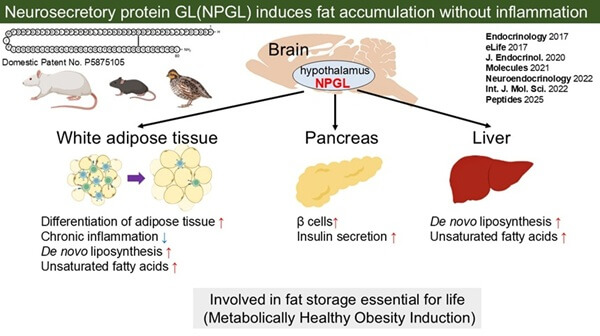
Mechanism of Action of NPGL
Although fat accumulation often has negative connotations (i.e., obesity), it is essential for developing secondary sexual characteristics, protecting the body, staying warm when it’s cold, and hibernation. The fat stored by NPGL is healthy, consisting of unsaturated fatty acids.
Having been selected by the Japan Science and Technology Agency (JST) for its Fusion Oriented Research for Disruptive Science and Technology program, this research project for the Elucidation of the Fat Accumulation Mechanism of the Neuropeptide NPGL in Cold Adaptation is aimed at clarifying the important role that NPGL plays in fat accumulation among hibernating and migratory animals.
The study uses the African clawed frog (Xenopus laevis), an amphibian, as a model organism. It does not hibernate but is cold tolerant, and when water temperature cools to around five degrees Celsius, its heart rate slows significantly and its metabolism slows to a state similar to hibernation. At this time, I discovered elevated expression of the gene that encodes NPGL in the brain. This raises the question: If the brain is prevented from making NPGL, would the frog become unable to survive at low temperatures? I am planning experiments to find out.
Excessive introduction of NPGL into rats and mice has been shown to decrease metabolism in addition to fat accumulation. One possibility, therefore, is that NPGL functions to lower metabolism, which results in fat accumulation.
Artificial Hibernation, An Essential Requirement for Space Travel—A Possible Application of NPGL?
I am also working on research into other applications, such as promoting growth and increasing fat production in poultry. In current practice, chickens farmed for meat are kept in light for virtually 24 hours a day in order to fatten them rapidly so they can be ready for processing quickly. However, these methods come with animal welfare concerns. For instance, they are known to lead to liver dysfunction and other health issues. In contrast, experiments with quail have shown that prolonged darkness leads to elevated expression of the gene that encodes NPGL in the brain, resulting in an increase in unsaturated fatty acids. I aim to improve the environment in which chickens are farmed while still producing chickens that are rich in unsaturated fatty acids by adjusting sunlight hours and adding plant-based feed (e.g., sunflower seeds) that is rich in unsaturated fatty acids to their diet. Food containing unsaturated fatty acids is also beneficial for human health.
Looking to the future, I hope that hibernation research will one day be useful for medical purposes. For instance, when blood flow is stopped temporarily, for example, due to cerebral infarction or during an organ transplant, toxic substances such as active oxygen are produced when the blood flow is restarted, which can cause damage. However, hibernating frogs regulate the production of active oxygen by suppressing mitochondrial activity.

 Back to List