
Interview of Associate Professor Satoru Muramatsu
Probing Fundamental Theories of Chemical Bonding through Gas-Phase Spectroscopy of Molecules
| Program | JST FOREST (Fusion Oriented REsearch for disruptive Science and Technology) Program | Researchers selected in the FY | 2024 |
|---|
Want to Find a Molecular Needle in a Compound Haystack? Just Extract the Molecule You Need from Those You Don’t!
My research focuses on an experimental method of observing molecules extracted in a vacuum, which is called gas-phase spectroscopy. Because it is a task of finding one small thing from a complex mass of many things, I liken it to finding a needle in a haystack. Or, are you familiar with the children’s picture book, ‘Where’s Wally?’? It’s a game-style picture book where you try to find a single character named Wally within a complex illustration of a busy scene featuring hundreds of people.
For example, let’s say you want to study a molecule that’s dissolved in an aqueous solution. You know that molecule is in there, but it’s hidden among a whole lot of water molecules, impurities, dissolved air, and even heat from the atmosphere. These obscure the molecule, making it difficult to ascertain its shape (structure) or the strength of the connections between its constituent atoms (bonding). This visual ‘clutter’ might be similar to a page where Wally is hidden within a vibrant beach scene, and you have to comb the sand and sea areas to locate him.
In the haystack or Wally metaphors, I would much prefer it if all the other distractions were
removed so that the target was visible right from the start—and I think the same applies to chemical experiments, too. This is where gas-phase spectroscopy can be useful.
‘Gas-phase’ refers to a state where molecules are isolated in a vacuum—a state in which those obstacles are absent. Spectroscopy, meanwhile, is the study of the properties of molecules based on their response to being illuminated (in my case, by laser light). Observing how a molecule absorbs light of a specific color lets us understand its structure and bonding.
When we combine the gas phase and the spectroscopy method, it becomes possible to see the true nature of a molecule with the greatest clarity imaginable.
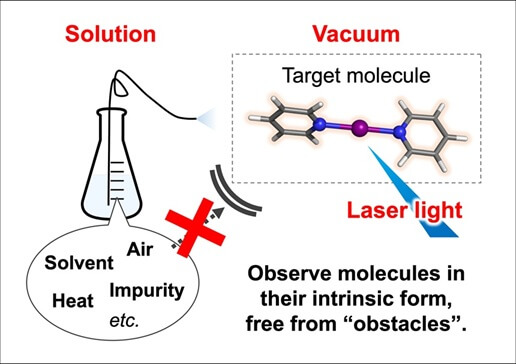
How a gas-phase spectroscopy experiment works.
Probing a 70-Year-Old Bonding Model Through Experiments
The main purpose of my research project is to fuse two discrete fields: gas-phase spectroscopy and organic main-group chemistry. Given this ambition to merge two fields, the project, titled ‘Probing Chemical Bonding in Main Group Compounds through Gas Phase Spectroscopy,’ has been selected by the Japan Science and Technology Agency for its Fusion Oriented Research for Disruptive Science and Technology (FOREST) program.
Organic main-group compounds, the subject of this project, are those in which elements like boron, phosphorus, silicon, and iodine are incorporated into the carbon skeleton of organic compounds. The most significant feature of organic main-group compounds is their unique chemical bonding, which is unlike anything found in ordinary organic compounds.
One example of such uniqueness is hypervalent compounds, which violate the octet rule we learn in high school, which says that atoms are stable when they have eight electrons around them. A theoretical model explaining this peculiar bonding was proposed as early as 1951 and has proven robust enough to withstand over 70 years of rigorous scientific scrutiny and remain in use today. This theoretical model of hypervalent compound bonding is now so fundamental that it appears in first-year university textbooks. However, no research has yet been reported that attempts to demonstrate this bonding model in experiments, particularly from a spectroscopic perspective—and only recently have advances in gas-phase spectroscopy made such an approach possible!
It may be a bit presumptuous to cite such a grand example, but bear with me: Einstein’s prediction of the existence of black holes was later confirmed by astronomers who were observing celestial bodies. There is a certain romance in that story; the interplay between theory and experiment, unfolding over time. I feel that there is a connection here, too: refining our ability to conduct experiments using gas-phase spectroscopy could permit us to learn more about existing theories of organic main group compounds.
Who does not, like me, feel excitement at the thought of the many mysteries waiting to be discovered inside the molecules that permeate our everyday existence?
Hand-Built Apparatuses Deliver World-Exclusive Data
While gas-phase spectroscopy is an excellent experimental method for observing the true nature of molecules, apparatuses for experiments like those are not sold anywhere in the world. My research group has had to do it ourselves: everything from drawing the blueprints to assembling the parts and getting the apparatuses up and running. It took years of hard work to get our current devices into operational shape, but the reward—obtaining data unavailable to anyone else anywhere in the world using hand-built equipment—is a joy unlike any other.
I chose this path because I enjoy developing equipment, but looking back, my love for apparatuses may have been sparked back in high school when I visited the particle accelerator at RIKEN (the institute where the element nihonium was discovered) and was captivated by the numerous giant experimental devices. The apparatuses I am building are nowhere near as grand as that, but I hope that my determination to build equipment and pursue its potential to the very limit brings me closer to the vision I admired that day.
I am now a few months into my FOREST project; I am working on first developing an interface that can efficiently introduce a diverse range of organic main-group compounds into a vacuum. Over the program’s seven-year period, I hope that the fusion of gas-phase spectroscopy and organic main-group chemistry will result in the creation of a new academic field.
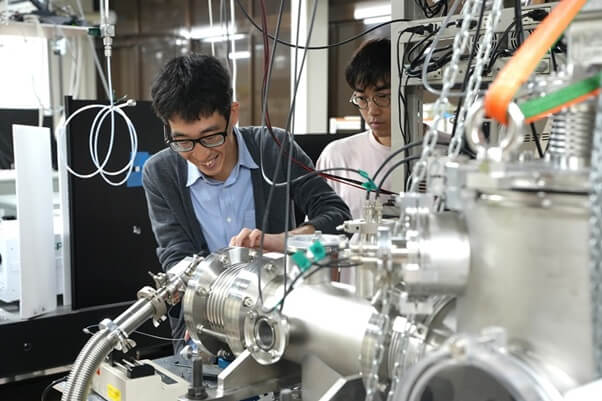
Adjusting a hand-built apparatus.
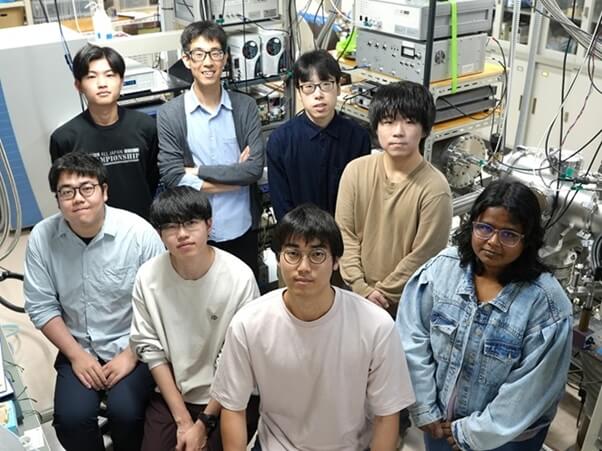
Dr. Muramatsu with students.

 Back to List