
Interview of Assistant Professor Haruka Sakai
Unraveling the Mechanisms of Communication to Help Solve Issues in a Super-Aging Society
| Program | JST Strategic Basic Research Programs (PRESTO) | Researchers selected in the FY | 2025 |
|---|
Analyzing Communication from Verbal and Nonverbal Perspectives
I study human communication from a viewpoint of sociolinguistics and interaction analysis. I use data collected through fieldwork to conduct granular analyses that incorporate gaze and bodily movements as well as speech. Human communication can appear to be an elusive topic, complex and chaotic, but a closer examination reveals that there are, in fact, structures and rules that can be grasped. I find it fascinating that some of those structures and organizations are shared across countries and cultures. For instance, listeners know that a falling intonation projects that a speaker is about to finish their turn, and that now is an appropriate moment to start subsequent turn in response.
I have always been fascinated by languages—ever since childhood—and linguistics was my major at university. As part of that, I learned about the study of interaction analysis, and I have come to realize that bodily behavior is just as important as speech in conveying something. Since then, my research has taken an approach that combines both of these. Sociolinguistics is part of the field of linguistics, and interaction analysis is rooted in sociology, so in that sense, my work incorporates perspectives and methods from multiple domains. Modern-day life demands deeper study of human communication, and the rapid evolution of robotics and artificial intelligence has led to increased interest in this discipline among information and engineering researchers.
The Quest for “Helpful but Not Overbearing” Support for the Elderly
My research project that has been selected for the Japan Science and Technology Agency’s PRESTO Strategic Basic Research Program focuses on the interactions that take place within the day-to-day practice of support for the elderly. My interest in this topic was sparked when, during fieldwork, I saw a local government official reaching out to lend a helping hand to an elderly person. It was a prime example of good help: not leaping in too soon, not leaving it until too late, and not forcing more “help” on that person than they wanted—a true Goldilocks moment. But what exactly was it that made that assistance so good?
I intend to use the 3.5 years allotted to me under the PRESTO program to collect, analyze, and present data relating to the day-to-day practices of support for the elderly. Indeed, given the primary importance of data for this study, the first year or so will be devoted to data collection. To that end, I will observe day-to-day support practices using cameras installed in elderly people’s homes, and also by following them around with a camera when they go outside. I hope to get around 100 hours each of at-home and outdoor footage. Naturally, I will only film those who agree to take part in the study (and whose families agree), and I am currently in the process of recruiting participants. From that footage, I will extract the situations in which the participants interact with others, and analyze the behaviors shown in order to identify situations where assistance was provided and those where the subject was in difficulty but got no assistance. In those situations where assistance was not provided, I will interview those who were present about why no assistance was provided. Through this analysis, I hope to shed light on what kind of conditions lead to what kind of support.
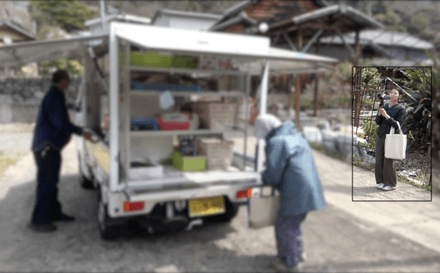
Collecting video recordings of an elderly person shopping at a “mobile supermarket.”
The main focus of this project is to consider how people provide help in a way that is not only useful, but that is also respectful of individuals’ dignity and humanity. In that sense, assistance that is not overbearing and does not exceed what they actually want is an underlying theme: How much does someone have to be struggling before it becomes appropriate to step in and help? The answer to that question will be an important factor in scientific and technological progress, such as the development of assistive robots. I believe that considering how technology should advance in society—including options that help but don’t “help too much”—is very much part of the remit of humanities and social sciences.
Past studies in this area have mostly been conducted in nursing facilities. However, because it is predicted that more elderly people will continue living in their own homes in the future, I think it is appropriate to focus this study on those living at home rather than in institutions, and on support provided by family and people in the community rather than by professionals. Japan’s population is one of the fastest-aging in the world, so a study like this—which has no Japanese precedent and therefore no precedent anywhere in the world—will likely provide useful insights, and I look forward to sharing the results internationally.
From “What I Cannot Do” to the Organization of Communication
I am interested in exploring the possibilities of human communication. In addition to communication among the elderly in the community, I have looked into multiple varieties of communication, both spoken and written, including online casual conversation, sports coaching, and academic writing. I am determined to delve deeper into these topics by putting myself in real-world settings.
I suppose that my inspiration to engage in this line of research comes from my tendency to become interested in things that I struggle with; I was motivated to pursue this project by an awareness of my own inability to provide good help to elderly people, and my studies into casual conversation was the result of my own awkwardness in that area. I hope that by shedding light on the underlying organization of communication, my research may help people see their own interactions in a new light, and perhaps feel a little more at ease with the way they interact.

 Back to List