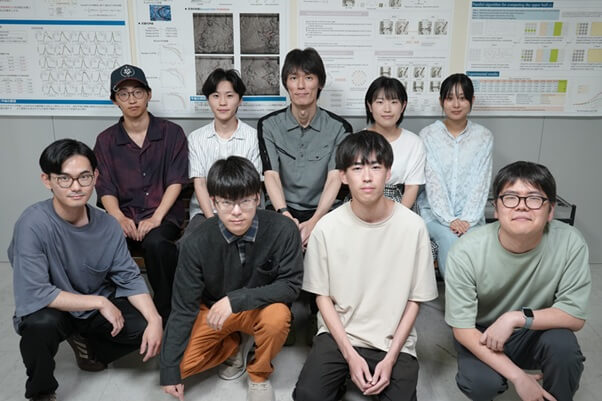
Toru Higaki, Associate Professor, Graduate School of Advanced Science and Engineering
On February 1, 2013, Hiroshima University established two new programs: the “Distinguished Professors” (DP) program and the “Distinguished Researchers” (DR) program. Individuals who are part of these programs are recognized as senior and junior faculty members respectively, who are engaged in extraordinarily distinguished research activities.
Deep Learning Revolutionizes CT Scan Image Quality; A Boon for Medical Practice and Industry
How AI Improves CT Scan Image Quality While Reducing Radiation Dose
My research is focused on image processing for medical purposes; the aim is to achieve more accurate diagnoses with less burden on patients. I am particularly determined to improve computer tomography (CT) scan image reconstruction and quality. As an undergraduate, I was part of a group studying computer graphics; I gravitated toward medical images because my advisor was in a joint research project with a medical device manufacturer.
The medical industry is full of unmet needs, and we often hear from those on the front lines about the kind of technologies they want or the kinds of things they want to achieve. Being able to pursue research in a way that addresses these needs is greatly rewarding, and it is gratifying to know that my research outcomes are benefiting many people.
Currently, I am working on a joint project with a major Japanese medical device manufacturer on a more advanced CT device. This is an industry-academia collaborative project to develop technologies that can be incorporated into equipment used in real-world applications.
CT uses a gantry in which an X-ray source rotates around the patient, creating cross-sectional images of the body based on the attenuation of X-rays passing through the tissues. Using greater volumes of X-rays results in better image quality, but at the cost of a higher dose of radiation. Our research group is using deep learning, the technology behind AI, to improve image quality so as to enable reconstruction of CT images to a high level of resolution even when those images were taken using small X-ray dosages.
Reducing the radiation dose is important—especially among younger patients, who are more sensitive to radiation, and whose longer remaining lifespans mean the effects are relatively larger. A core aim of my study is to maximize the balance between the usefulness of CT scans and the radiation risks through improvements in image quality.
An Engineering Background Proves Useful When Collaborating with the Medical Community
I use deep learning in two ways in image processing. One is noise reduction. A lower dose of X-rays results in images with a lot of noise, but by having the computer “learn” from vast volumes of old CT scans, we have succeeded in developing a technology that can significantly reduce image noise.
The other is super-resolution imaging. Super-resolution imaging is a processing method used in modern 4K TVs and the like; AI is used to estimate finer details based on low-resolution images and reconstruct contours and details with clarity. It is distinctive because it “learns” from large volumes of past CT images, which enables it to make certain judgments (e.g., “I recognize this pattern of shading from previous images; thus, there is a high probability that the internal structure of the organs looks like this”) and generate images accordingly. In the past, reducing image noise resulted in blurring, but by combining these two ways of using deep learning, it is now possible to reduce noise without compromising resolution, thus resulting in images clear enough for use in clinical settings.
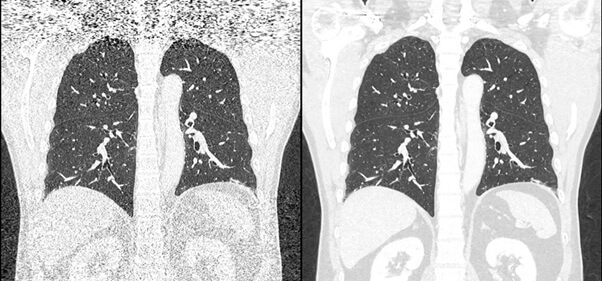
A CT scan of a chest (Left: An image made using conventional methods. Right: An image made with the deep-learning method.)
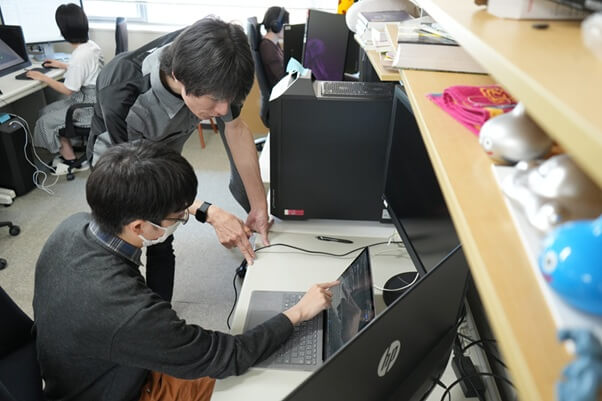
My background is in engineering, but since entering graduate school I have been a member of the Department of Diagnostic Radiology Laboratory at the university’s Graduate School of Biomedical and Health Sciences, where I pursued my research amid constant interaction with clinicians. Thus, my strength lies in my combination of an engineering background and a decade of ongoing experience at medical school, where I have worked closely with clinicians in the field.
The Common Thread: A Desire to Be Useful to People and Society
In recent years, I have been working on a CT system using a new semiconductor detector. I see that overseas companies are releasing X-ray detectors that use new materials, but as yet only a few Japanese companies are working on developing things like these. That’s why I find it so rewarding to be able to engage in research together with cutting-edge companies in Japan. CT devices that use semiconductor detector technology are able to capture structures in much finer detail, and can produce high-quality images even with low levels of radiation. I have high hopes that these breakthroughs in hardware technology can build on the image quality improvements we have achieved thus far through software, and then combine with deep learning to spark further performance improvements.
Meanwhile, my joint research is expanding beyond the medical industry; we are now also working with a company headquartered in Hiroshima. We are developing technology to improve product quality control and error detection by turning the sounds of the production line into visual images for processing. For example, we could make a system for a car production facility that “learns” a huge variety of sounds made by normal, well-running engines and can use that “knowledge” to detect even slight irregularities, thus allowing errors to be identified and their causes investigated.
As you can tell by the aims, contents, and range of my research projects—e.g., in healthcare, improving X-ray diagnosis accuracy with lower radiation dosages in the medical field; in industry, improving quality while reducing workload—the thread that connects all of my work has been a desire to be useful for people and society. By combining the fundamental technologies of image processing with deep learning, I hope to continue creating quality-enhancing solutions for the healthcare and industrial sectors.