
Distinguished Researcher Hanae Inami, Hiroshima Astrophysical Science Center
On February 1, 2013, Hiroshima University established two new programs: the “Distinguished Professors” (DP) program and the “Distinguished Researchers” (DR) program. Individuals who are part of these programs are recognized as senior and junior faculty members respectively, who are engaged in extraordinarily distinguished research activities.

Associate Professor Hanae Inami at the Hiroshima Astrophysical Science Center (Photo by Hideki Ikeda)
Associate Professor Hanae Inami at the Hiroshima Astrophysical Science Center specializes in astronomy, with a particular focus on galaxies beyond the Milky Way — a field known as extragalactic astronomy. Her main targets are dusty galaxies, which emit strongly in the infrared spectrum.
Inami has been fascinated by space since childhood, though during her school years she sometimes questioned whether she could pursue that passion because of challenges with mathematics. In her final year of high school, however, she discovered how physics uses math to describe the universe. That realization transformed her perspective and reignited her enthusiasm for space.
When Inami entered graduate school, infrared (IR) astronomy was still a relatively new and rapidly developing field. Around the same time, Japan had just launched its infrared space telescope, AKARI, and the United States was operating the Spitzer Space Telescope, which also observed in the infrared. Inami was captivated by the opportunities these missions opened for exploring the hidden universe.
What drew Inami to infrared astronomy was the unique window it offers into a hidden universe. Many galaxies, especially those rich in dust, are difficult to study with visible light because dust absorbs and scatters it. But that same dust re-emits energy in the infrared, making IR observations the best way to uncover what is happening inside these obscured regions—where much of the star formation in the universe actually takes place.
Infrared astronomy is also powerful for exploring the distant universe. As the cosmos expands, light from faraway galaxies is stretched, or redshifted, to longer wavelengths. This means that radiation originally emitted as visible or ultraviolet light can arrive at Earth as infrared. Observing in the infrared therefore allows astronomers like Inami to study both dusty nearby galaxies and some of the earliest galaxies in the universe.
All galaxies contain cosmic dust — microscopic solid grains made from heavy elements such as carbon and silicon. What sets dusty galaxies apart is their unusually high dust content: although dust typically makes up only about 1% of a galaxy’s total mass, it has an outsized effect by absorbing starlight and re-emitting it in the infrared. This makes dusty galaxies exceptionally bright at those wavelengths. The dust itself originates in the life cycles of stars, forming when stars shed material in their late stages or explode as supernovae. By analyzing the infrared spectra of these galaxies, astronomers can probe the composition of the dust and gain insights into the processes shaping galaxies across cosmic time.
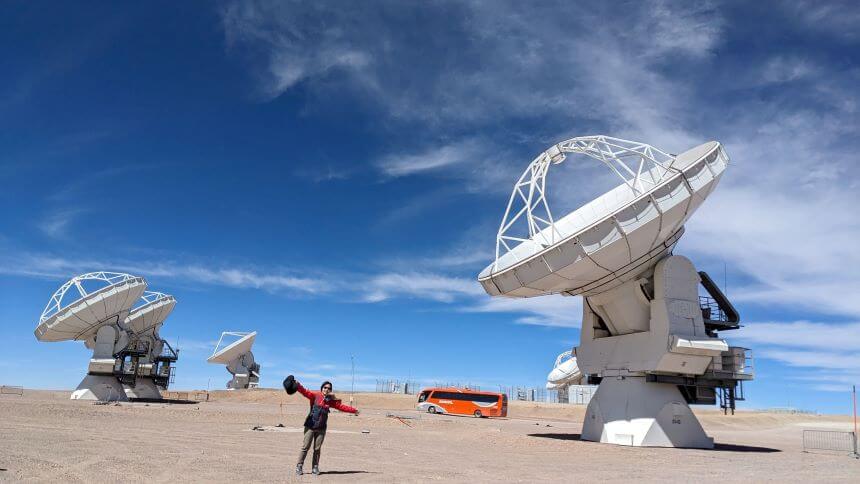
Hanae Inami at the Atacama Large Millimeter Array (ALMA), Chile, next to the radio telescopes that comprise the interferometric array. (Photo courtesy of Hanae Inami)
Inami has dedicated her career to unraveling the mysteries of dusty galaxies. She began with a focus on infrared astronomy, but during a postdoctoral position in France she expanded her expertise into optical observations. That experience allowed her to adopt a multi-wavelength approach — bringing together data from radio waves to ultraviolet light to build a fuller picture of how dusty galaxies form and evolve.
Her work has contributed to a major shift in how astronomers view the early universe. For a long time, scientists assumed that the young cosmos contained little dust, since dust forms mainly from dying stars and supernovae. Inami’s studies, however, revealed significant dust emission even in very distant, early galaxies. This discovery showed that galaxies, and the universe itself, were evolving much faster than previously thought.
Because Earth’s atmosphere blocks most infrared light, Inami’s research depends on space-based infrared telescopes — rare and short-lived resources. Looking ahead, she is preparing for the upcoming PRIMA mission (the PRobe Far-Infrared Mission for Astrophysics), currently scheduled for launch in 2031. This next-generation observatory promises to open an even clearer window onto the hidden universe.
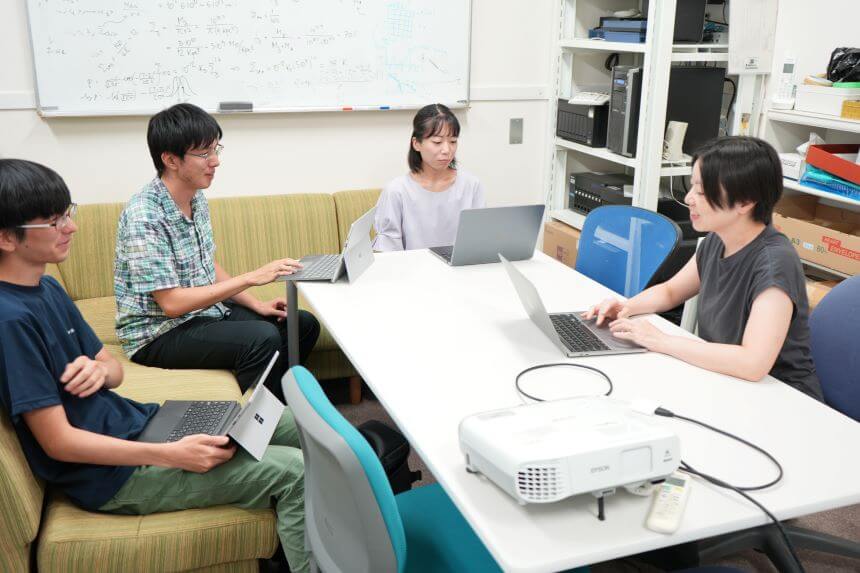
Inami’s students discussing their graduate thesis projects with her. (Photo by Hideki Ikeda)
Inami’s ultimate goal is to chart the cosmic history of dust: how much there is, where it comes from, and how it shapes the evolution of galaxies. Current observations reach back about 10 billion years, but she hopes to push that record to nearly 13 billion years — close to the dawn of galaxy formation after the Big Bang — so we can better understand the role dust has played in the story of the universe.
For more information on Associate Professor Hanae Inami’s career and research achievements, please see the Profiles of Faculty and Research Scholars.
Written by Sohail Keegan Pinto, Science Writer (Specially Appointed Academic Research Fellow)
