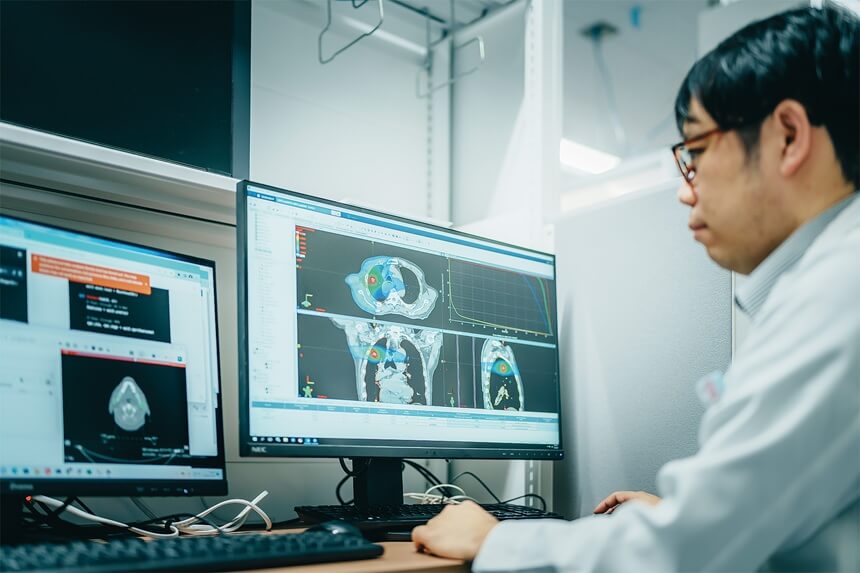
Daisuke Kawahara, Associate Professor, Hiroshima University Hospital Division of Clinical Radiology
On February 1, 2013, Hiroshima University established two new programs: the “Distinguished Professors” (DP) program and the “Distinguished Researchers” (DR) program. Individuals who are part of these programs are recognized as senior and junior faculty members respectively, who are engaged in extraordinarily distinguished research activities.
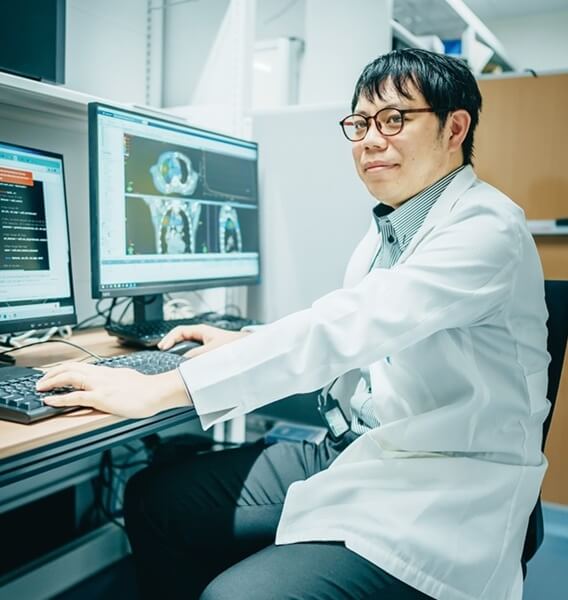
More than Just a Prognosis Prediction Tool: Harnessing AI Imaging to Advance the Possibilities of Medicine
Aiming for Better Cancer Treatments with AI
Radiotherapy is one of the three core cancer treatments, along with surgery and chemotherapy. A solid theoretical and practical grounding in physics is essential to properly carry out the various process of radiotherapy, including controlling the radiation dosage, administering it, as well as developing and maintaining the equipment, and much more besides. All three of these treatments involve formulating a treatment plan for each patient based on a variety images—e.g., CT and MRI scans—taken in advance.
I started out as a radiology therapist but switched to medical physics because I wanted to be part of the development of new technologies changing the face of medical practice without giving up my place at the clinical coalface. This led to my interest in medical AI. AI is gaining traction throughout the healthcare sector, but its use is particularly noticeable in the field of medical physics, where computing breakthroughs have a direct impact. Here, it is used for things like drawing up radiotherapy plans. I focus on AI as part of my research, and I hope to harness the power of AI imaging to help make not just radiotherapy but cancer treatments more effective as a whole.
From Prediction of Prognosis to Identification of Underlying Factors with AI
My research involves using AI to predict radiotherapy outcomes based on CT and MRI scans of patients’ lesions taken prior to radiotherapy. Although it is possible to determine a cancer’s stage with the human eye, predicting how well a treatment will work based on images of cancers at similar stages is not so easy. What we can do, though, is feed AI huge volumes of image data to learn from, so that it can predict whether or not radiotherapy will effective.
Research into AI’s ability to make predict what a prognosis might be based on pre-treatment images is not new. But there are still issues to be confronted. For instance, when the AI correctly predicts that a patient’s prognosis is positive, then fine, we can carry out the planned treatment, but determining the best course of action for patients whose prognoses are determined to be poor remains a challenge. My hope is to advance AI-based image assessment to the next stage beyond mere prognosis prediction. I aim to develop AI-based drug discovery and treatment condition search technologies that can be useful even in cases where a patient’s prognosis is not good, for instance by using those same images to come up with effective drugs or identify effective radiotherapy conditions.
So far, AI-based prognosis prediction has been able tell whether a patient has a positive or negative prognosis based on that individual’s images, but it cannot yet explain why it thinks so. By combining diagnosis-by-image with biochemical data (e.g., genetic and pathological data), it is possible to elucidate the factors leading to poor prognosis. Once those biochemical factors are known, it will be possible to use new AI to seek out suitable drugs and radiotherapy conditions.
An AI-based system that uses images and biochemical data to analyze the causes behind prognoses has already been made, and has reached the stage of animal testing to verify the accuracy its analyses. My near-term goal is to build upon this foundation, creating a system capable of exploring effective drugs and radiation conditions informed by our analysis.
The Ultimate Image-based Tailor-made Medical Care
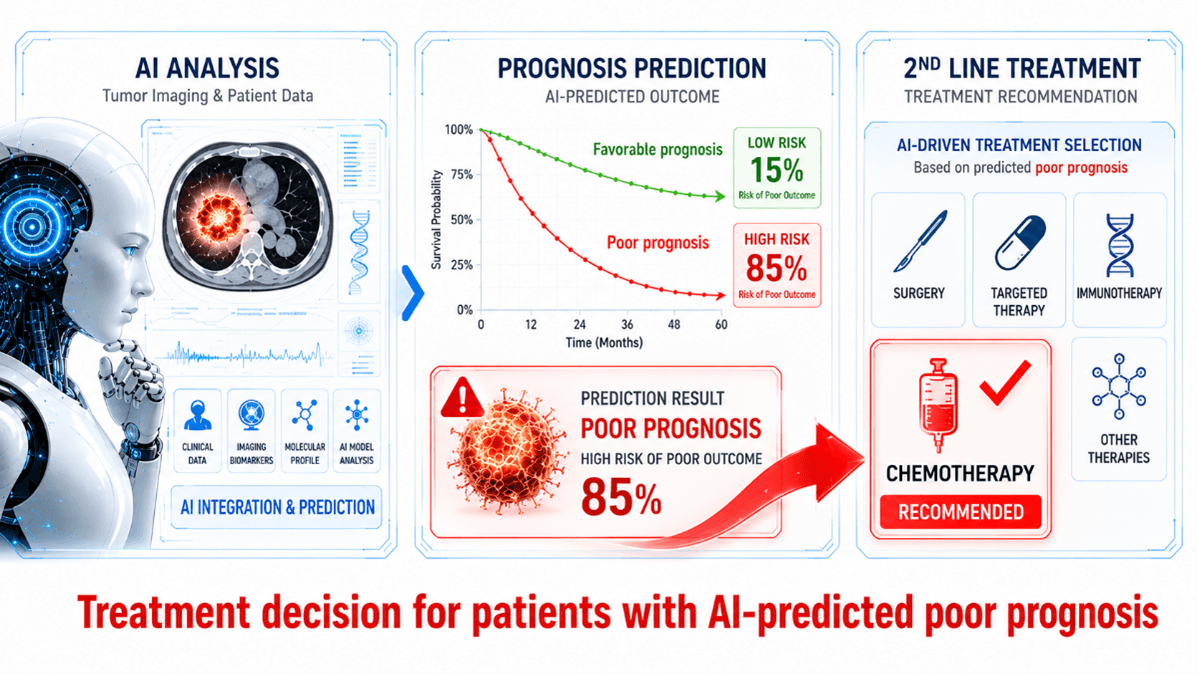
An image of how AI predicts a prognosis and proposes a treatment plan
My longer-term goal is to develop a system that will lead to drug discovery, i.e., that can predict the prognoses of patients undergoing radiotherapy based on images, analyze the causes of negative prognoses, and design new drugs optimized for their individual treatments. This is medical care tailor-made to deliver the best treatment for each patient.
In general, tailored medicine care is personalized based on each patient’s genes and other biochemical information, but I aim to use a different approach: using AI to search for optimal treatments based on images. I feel that the information contained in images has the potential to transcend the limitations of conventional medicine.
For example, in current tailored medical care, a small portion of the cancer cells are harvested and tested for genes to determine what kind of treatment will be effective. But cancers are complex and heterogeneous; within a single cancerous tissue, there might be active cell division in some parts and necrosis in others. Thus, it is possible that the information gleaned from a few cells may not be sufficient to make a correct judgment about the cancer as a whole. In contrast, I believe that more information can be obtained from images, because these can capture a cancer in its entirety.
Ultimately, I hope to combine this with the computer simulation technology for cancer cells that I am working on alongside my AI research. If we can use AI to elucidate the factors behind a patient’s prognosis based on their CT and MRI scans, and then recreate individual cancer cells and extrapolate how they may evolve using theoretical simulations, it will therefore be possible to understand the whole process—from the occurrence of cancer cells to treatment outcomes—from a theoretical standpoint as well as an AI standpoint.
Medical AI is progressing so far and has such vast potential that I believe its limits are beyond human estimation. If it can take images and use these to come up with optimized treatments that would never have occurred to a human, surely that means AI can progress beyond any boundaries that we may imagine.